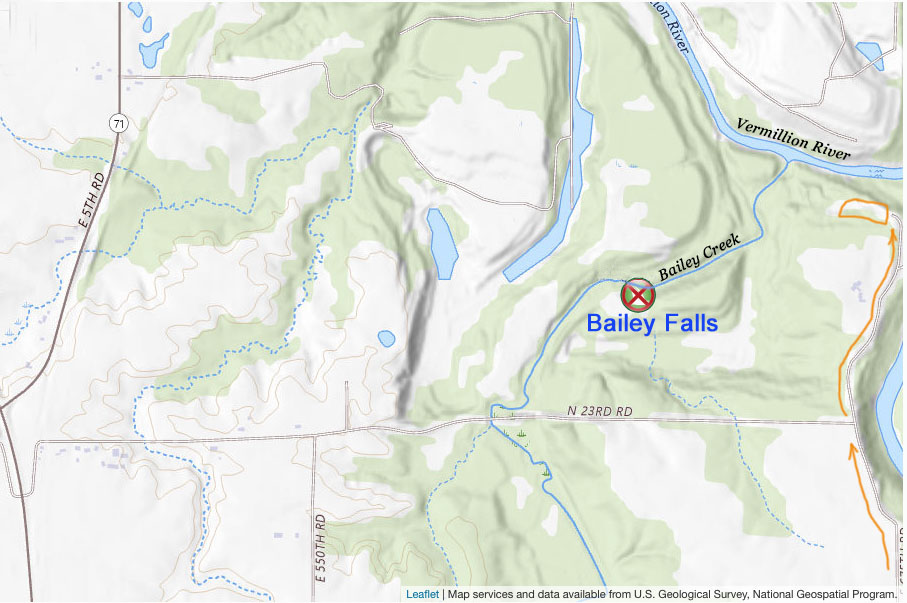
Bailey Falls Oglesby Illinois |
and Buffalo Pit in Utica Illinois COMING THIS FALL Bailey Falls The True Story and What You Didn't Hear On TMZ |
|
| In 2018 Buzzi UniCem USA sold it to the state of Illinois and it is now part of Starve Rock State Park. I would like to go see what that's like. |
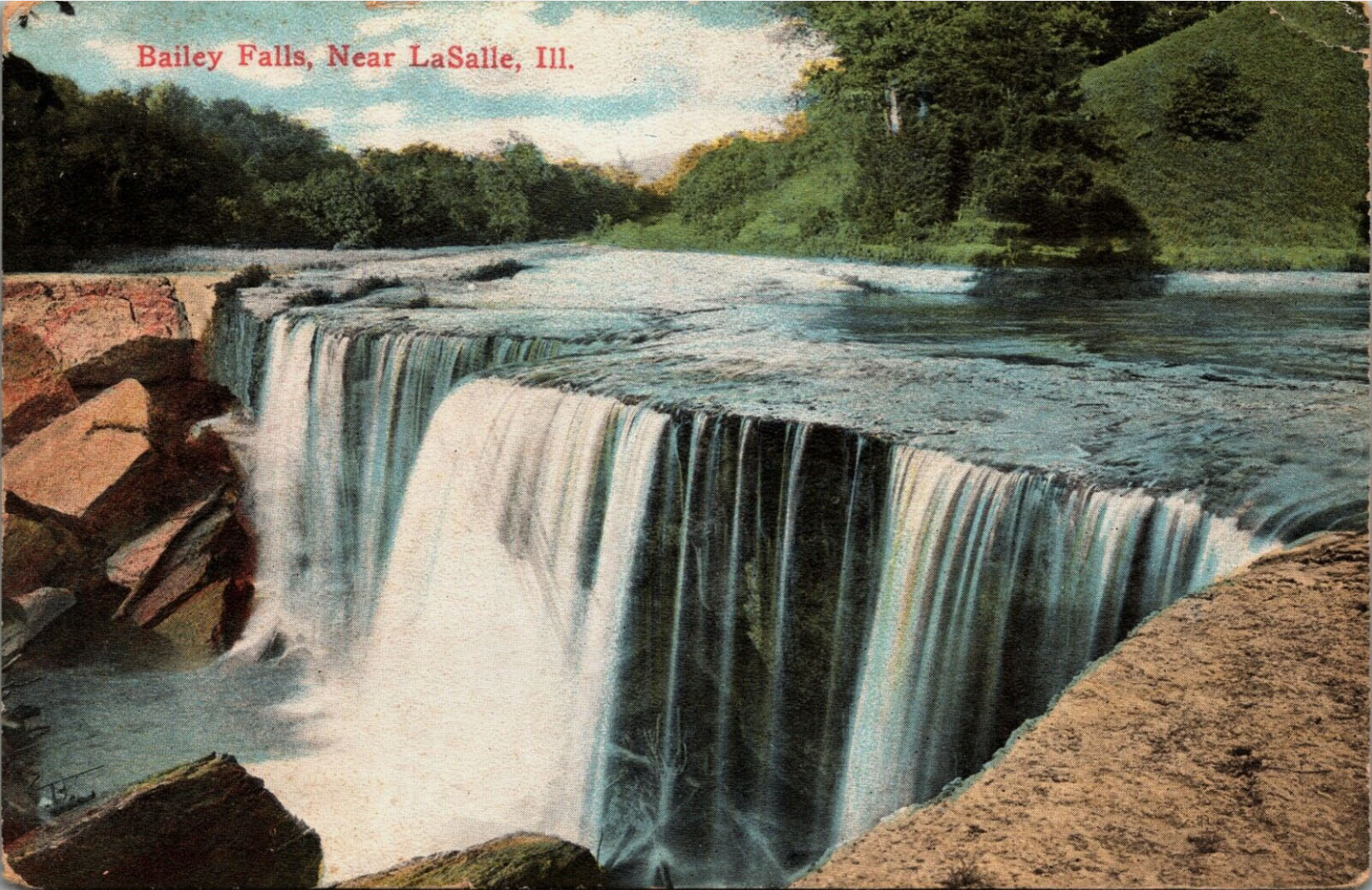
| This old Post Card says "Near LaSalle." This is like the 1930's, there was probably nothing around so they just said near LaSalle. |

This 1930's photo looks just like the Post Card. It's a early 4x4 in what looks like a 1920's Model T Ford Coupe. You can see the old promo film on those Model T's, it shows (brags) these are "Off Road" vehicles. Well yeah because just about everything was off road. Good roads were scarce to non-existant. Kinda funny this 2 wheel drive clunker was a serious 4x4. And it was.The film shows hillclimbing, going up big obstacles, down steep slopes. It's so lightweight and rickety it just bounces off and over obstacles. |
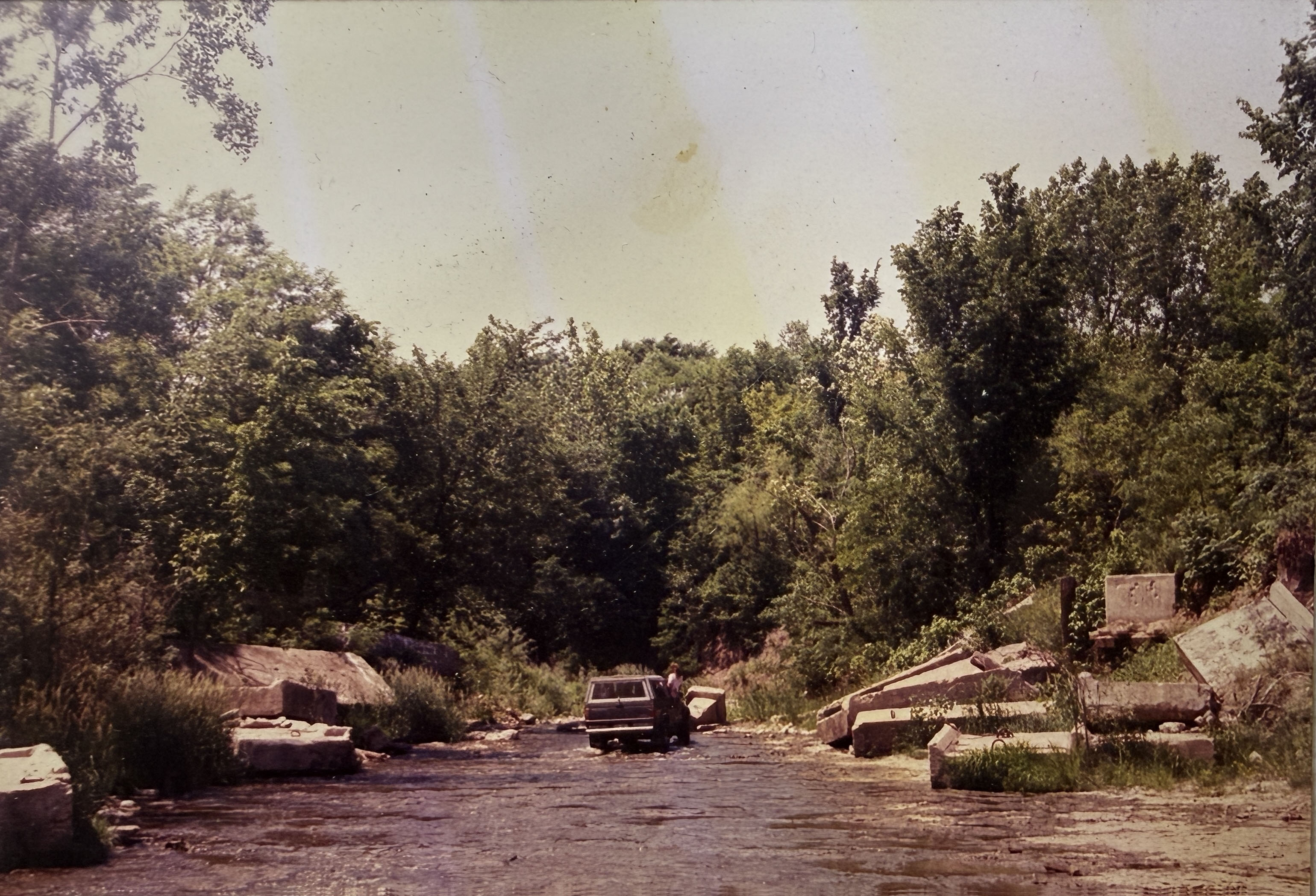
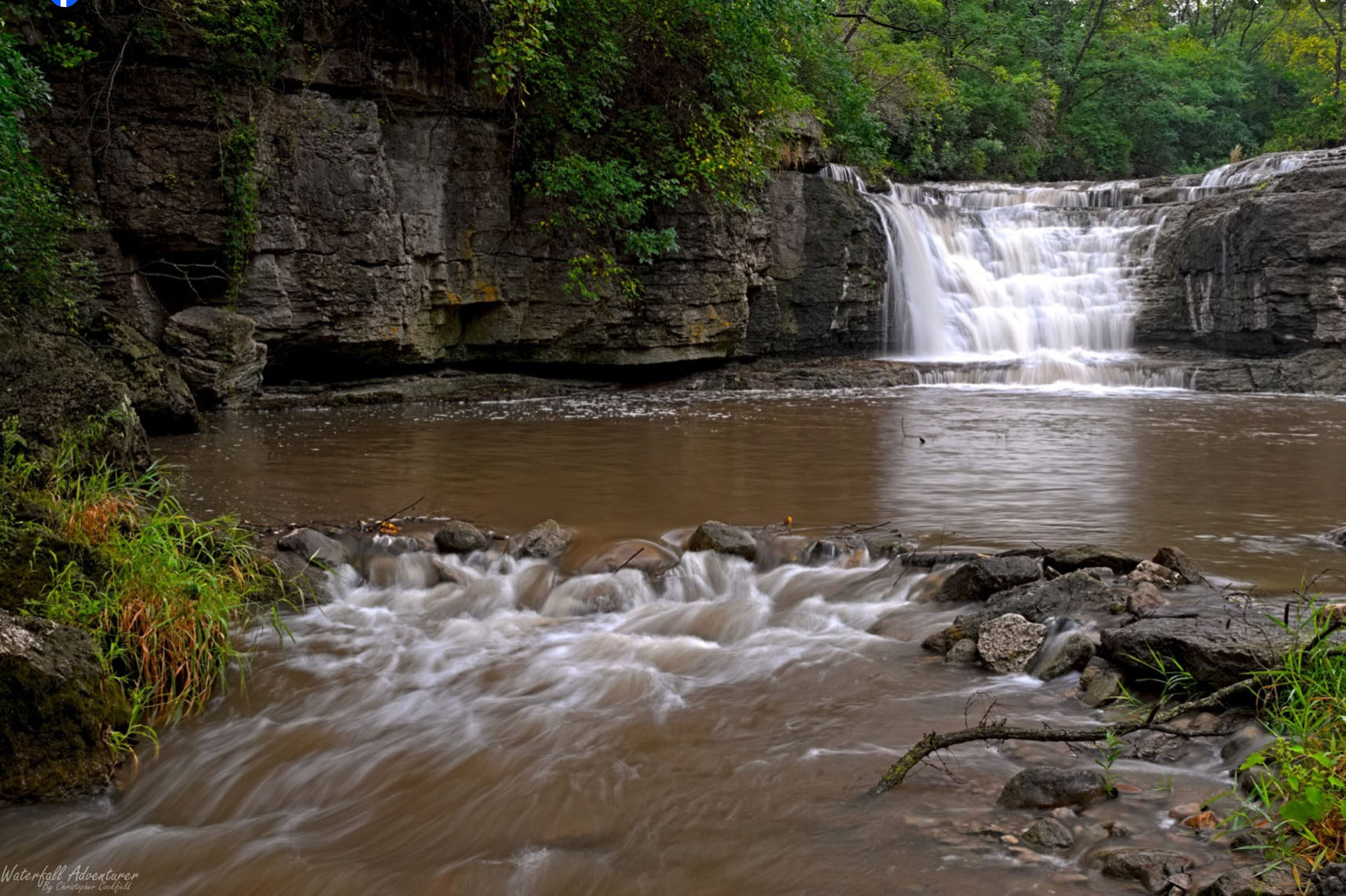
Here is what Bailey Falls looked like in the 1980's and 90's.
| Here is the upper trail from the Vermilion River to Bailey Falls. Thats my Toyota 4x4 it shocks me to see the places I took that vehicle, it had shitty Snow Tires no Lift Kit, completely stock. The water level is different in every picture. This was a very dangerous trail someone rode off the side and died, they helly Coptered the victim outta there. I don't remember what year that was. |
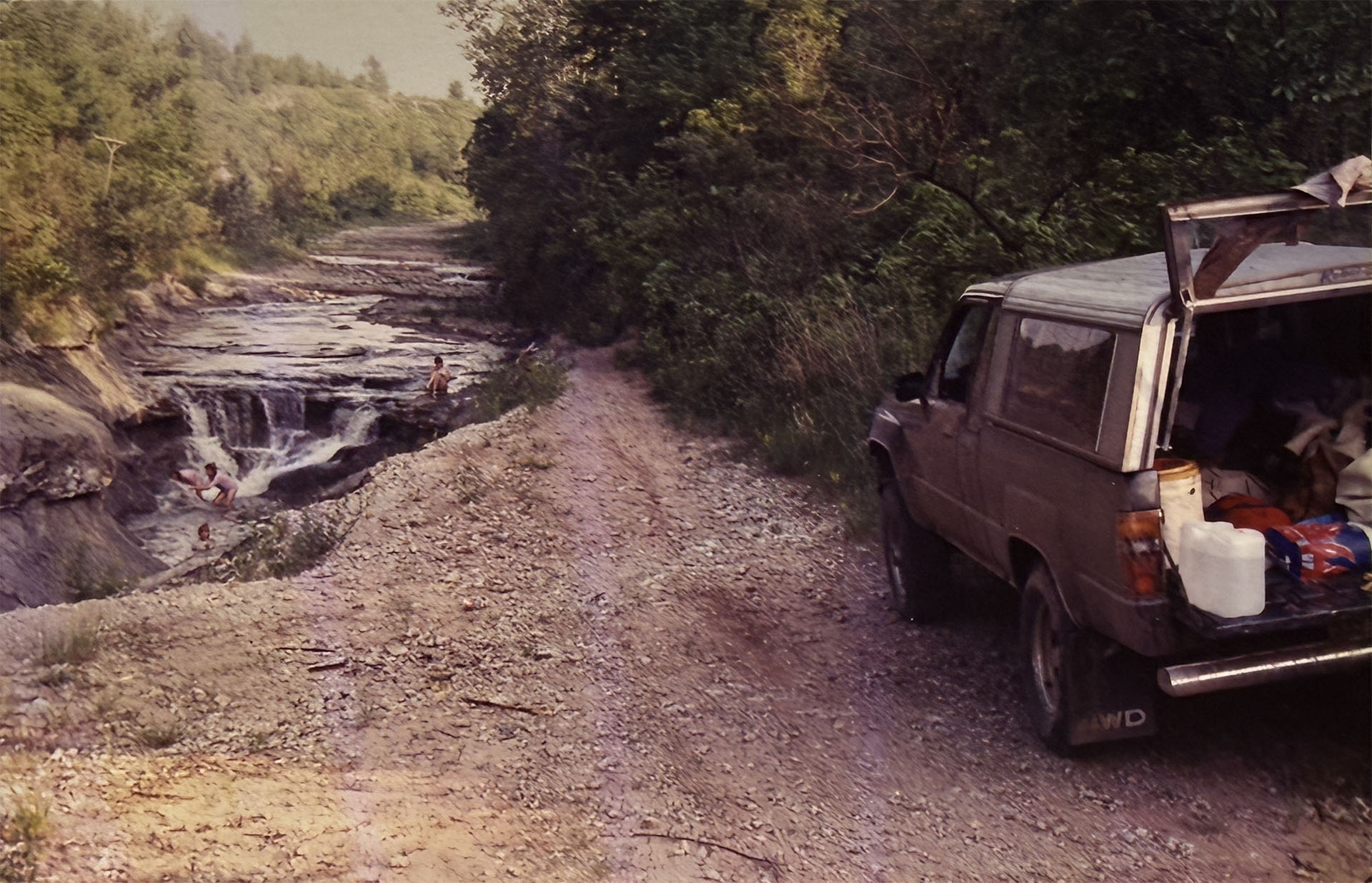
| This is just above the Falls. I was new to the concept of 4x4. I naively thought any vehicle that happens to possess 4-wheel drive meant you were a 4x4 hero. I was dangerously fearless and went everywhere with no kit. Not even a shovel. I had one of those small crappy Come-Alongs. It did save me a few times and then bent up and broke apart. |

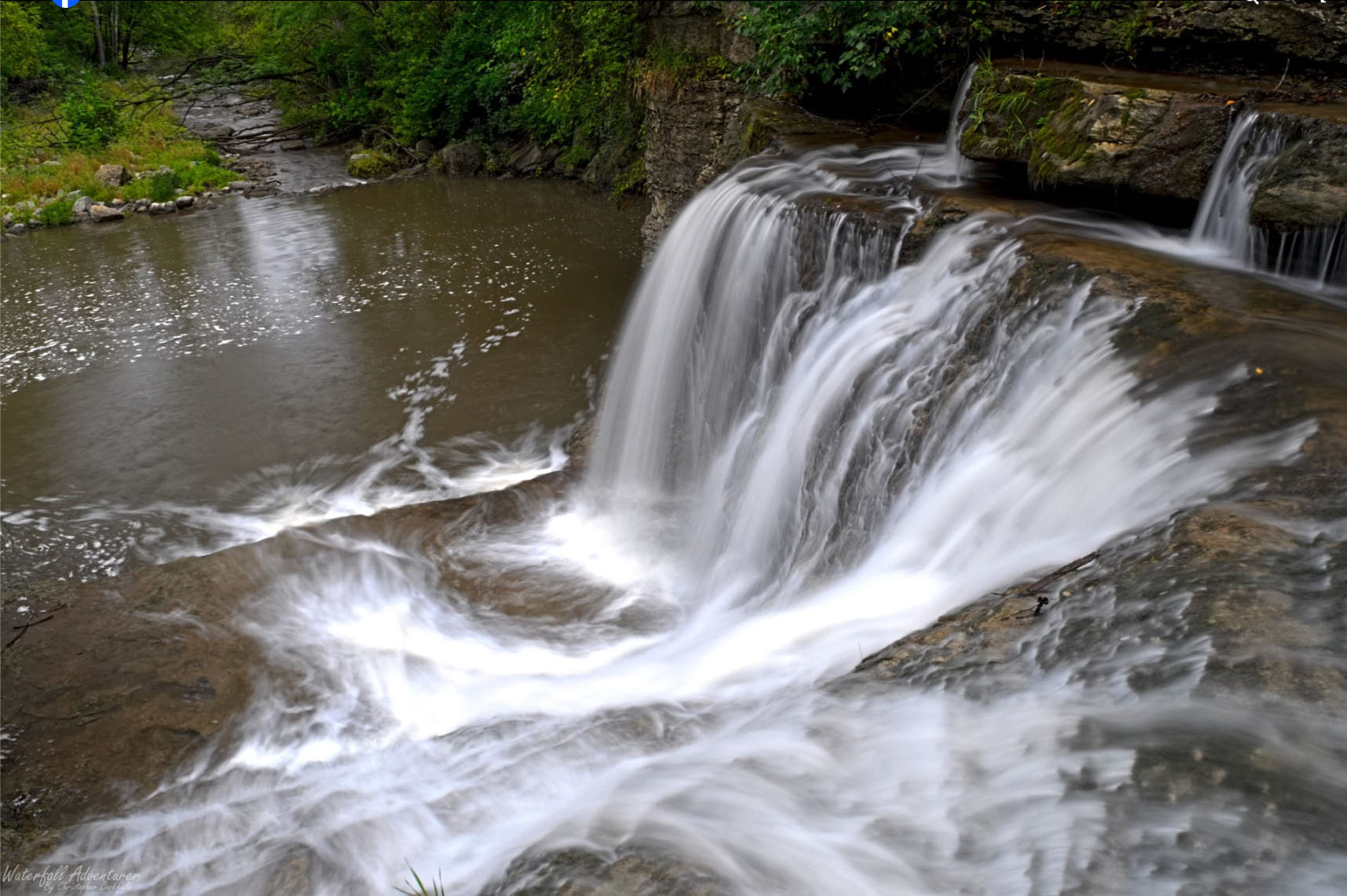
Depending on the rain the water level of the Falls could be deep or bone dry.
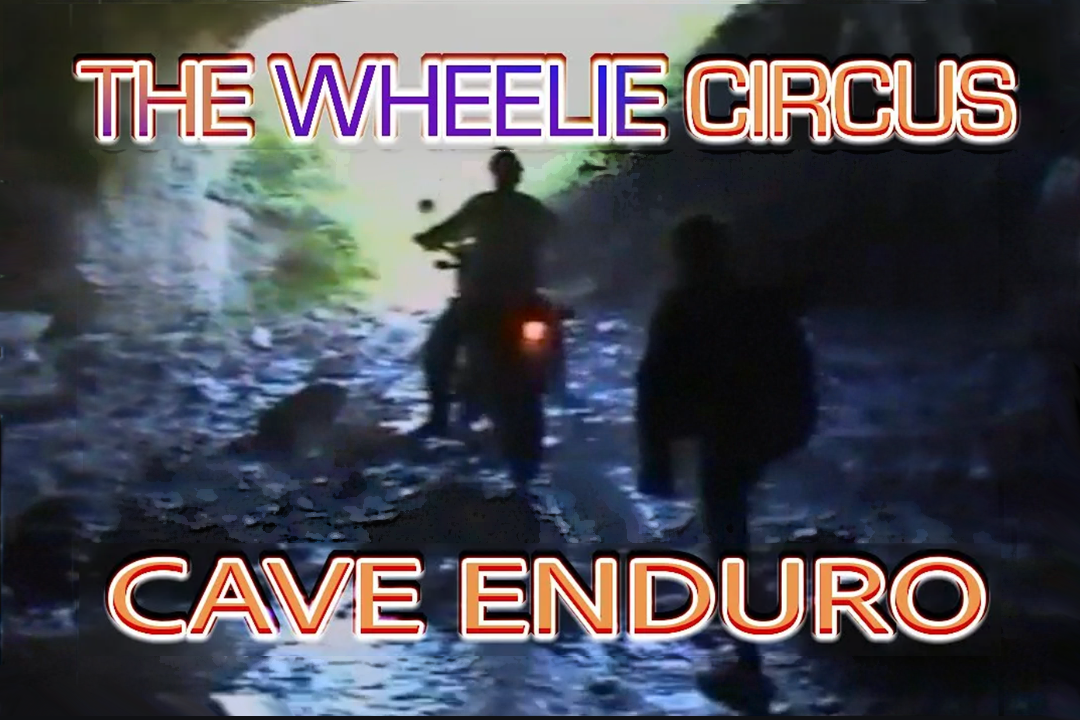
Let's pause here for a quick video episode from The Wheelie Circus
The Wheelie Circus at Bailey Falls
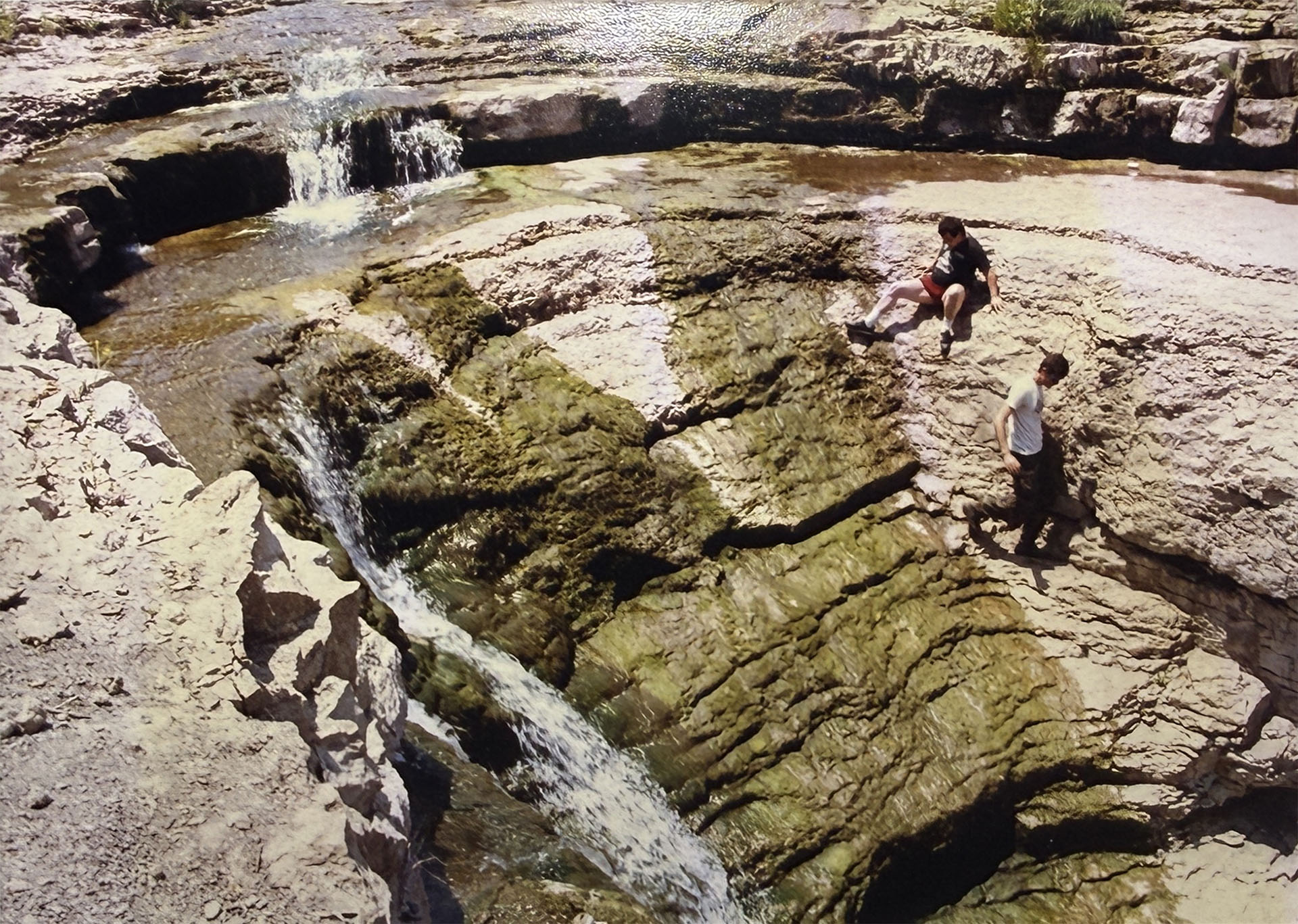
Here is a rare photo of the time we went out there and the Falls were bone dry.
This was in the 1990's. That's me and Jim I think Mar took the photo.
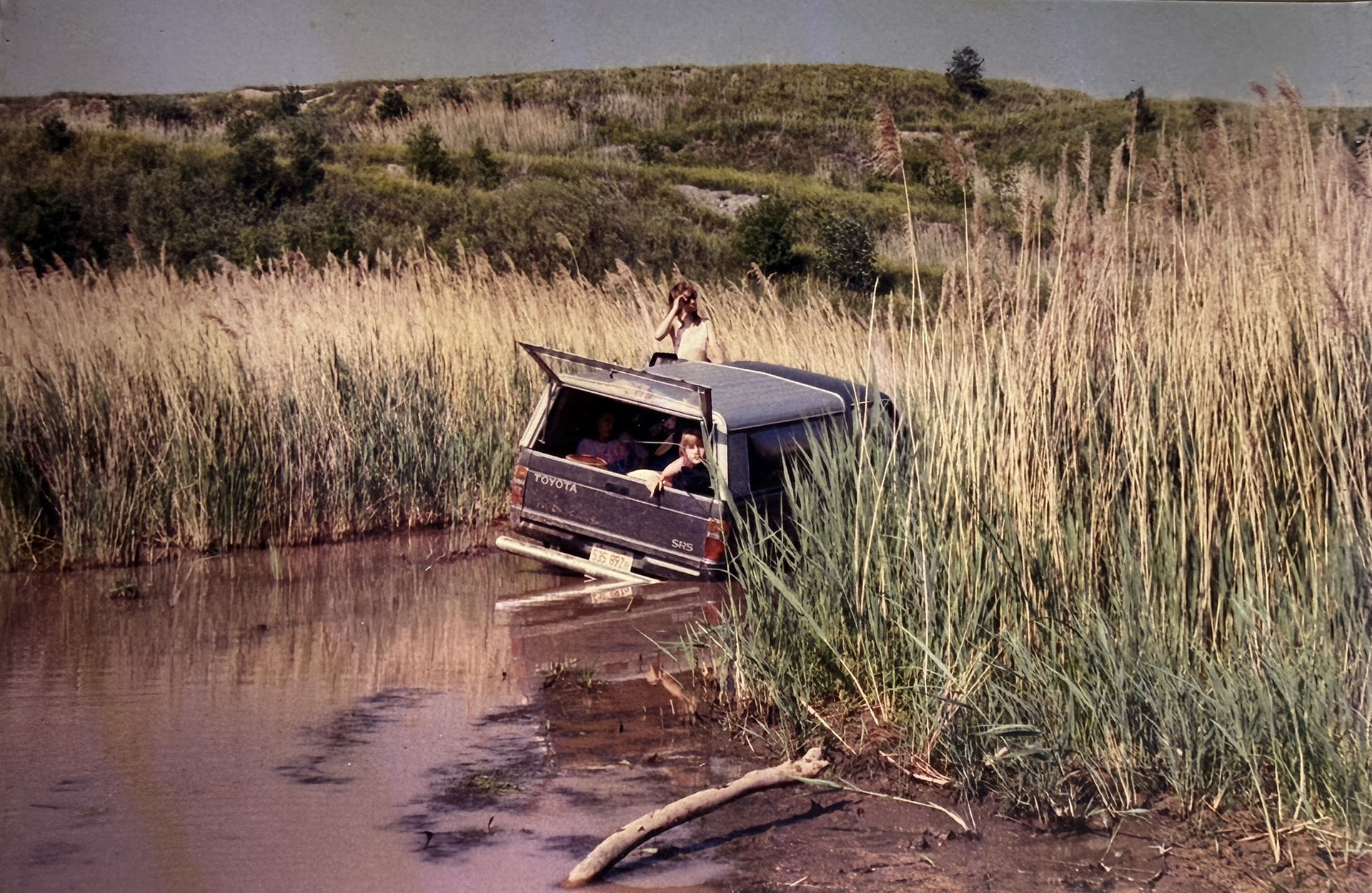
This is the 1980's. One of the many times I was stuck. In the quarry. Trying to find new ways to get to Bailey Falls. This was probably 1985. I had just arrived and I had a unopened cold 12 Pack of Beer. I told the girls wait here. I took the beer and walked looking for other 4x4's. I ran into a group O them I said I got a cold 12 pack for anyone who can pull me out. . |
| Needless to say I got pulled out. Sacrificed my beer -sigh- thats life. There used to be a group of regular 4x4 people out there, they would come out every summer. One of them we got to know is "Brad Carter" everyone around there knows him. He had a GMC Jeep that looked like a beater but he had a big V8 engine and big tires and he could and would go anywhere. They had a 4x4 Club. We would get rescued by some of them more than once. |

I have more photos and video too. Stay Tuned and Check back in a month or two. There is a slice of the Lone Star Quarry on the other side of the Vermilion River. The iconic "Iron Bridge" crossed over to that side. Over there was what we called "Caves" but were actually abandoned Mining Tunnels. We went in there but it got dark quick and there was water as well. It was a bit spooky. |
In the 1990's I had a Public Access TV Show called, "The Wheelie Circus" and it was mostly based on trips to Buffalo Rock, Lone Star Quarry and Bailey Falls. |

Lone Star Quarry, Bailey Falls, Oglesby Illinois.
There was only one road to get in the quarry. And it didn’t go much past the entrance.
You could park but to go any further required some sort of off road moto device.
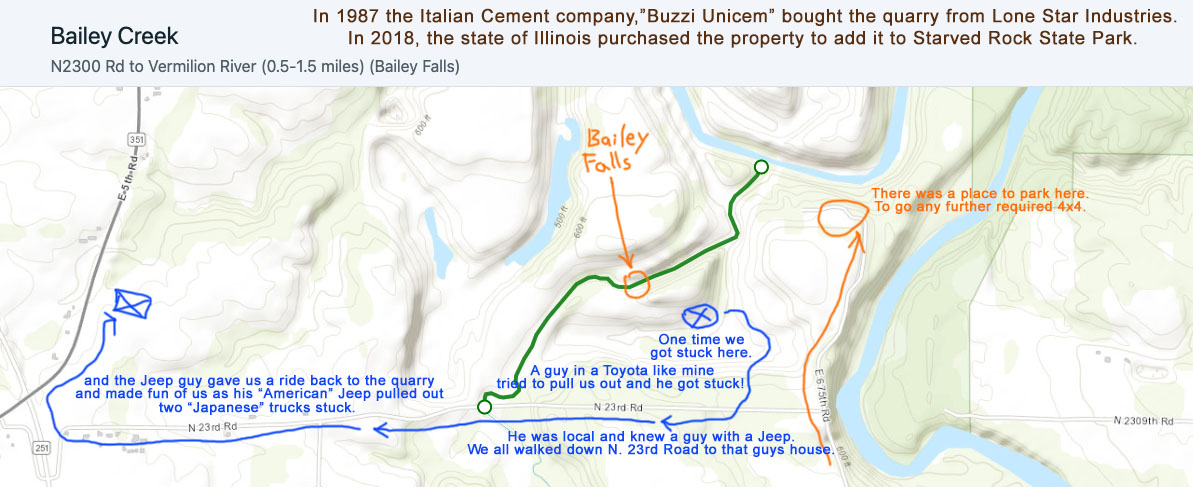
You can see here in this "AI" recreation (thatsa joke son) is the time
we got stuck trying to locate the backend way to Bailey Falls.
There were thick forest, barren swamp, open grassland, moonscape rock debis.
There was a large variety of things that could get in you in big trouble.
This professional AI diagram shows the time Brad Carter pulled us out.

Am I the only one who has video of Buffalo Pit in the 1990's?
The second half of this video clip is dirt Bike moto action at Buffalo Pit.
You might be that guy on the blue (Yamaha YZ?) who fell in the dirt
Buffalo Pit Dirt Bike action in Utica Illinois 1993
COME BACK HERE SOON KIDS WE GOT LOTS MORE PHOTOS AND VIDEOS!
and fossils? who knew
Roy Plotnick is a Paleontologist, geologist, ecologist, educator. Professor at the University of Illinois at Chicago. Author of Explorers of Deep Time. He says the Oglesby quarry has abundant, "Brachiopods." What the hell are Brachiopods you might ask? Me too. Brachiopods are marine animals belonging to the phylum Brachiopoda, characterized by having two hard shells (valves) on their upper and lower surfaces. They are often referred to as "lamp shells" and have existed for at least 550 million years, with a rich fossil record primarily from the Paleozoic era. Oh boy who knew. Professor Roy says, "One of the greatest challenges I face in teaching paleontology in Chicago is finding a place to bring my classes on field trips. I also am frequently asked by members of the public “where can I take my kids to collect fossils?” Unfortunately, there are currently are very limited number of places in Northern Illinois to collect fossils. There are only a few small roadcuts. Most exposures of bedrock are in commercial quarries, which are generally off limit to members of the public, including groups from schools and universities. Not long ago I found myself scrambling at the last minute to find a site to bring a field trip, because the quarry management rescinded our permission to visit. Alvin Harper, the park superintendent back in 2022: “The Matthiessen Annex project Capital Development Board project is still years away from official development.” |
|
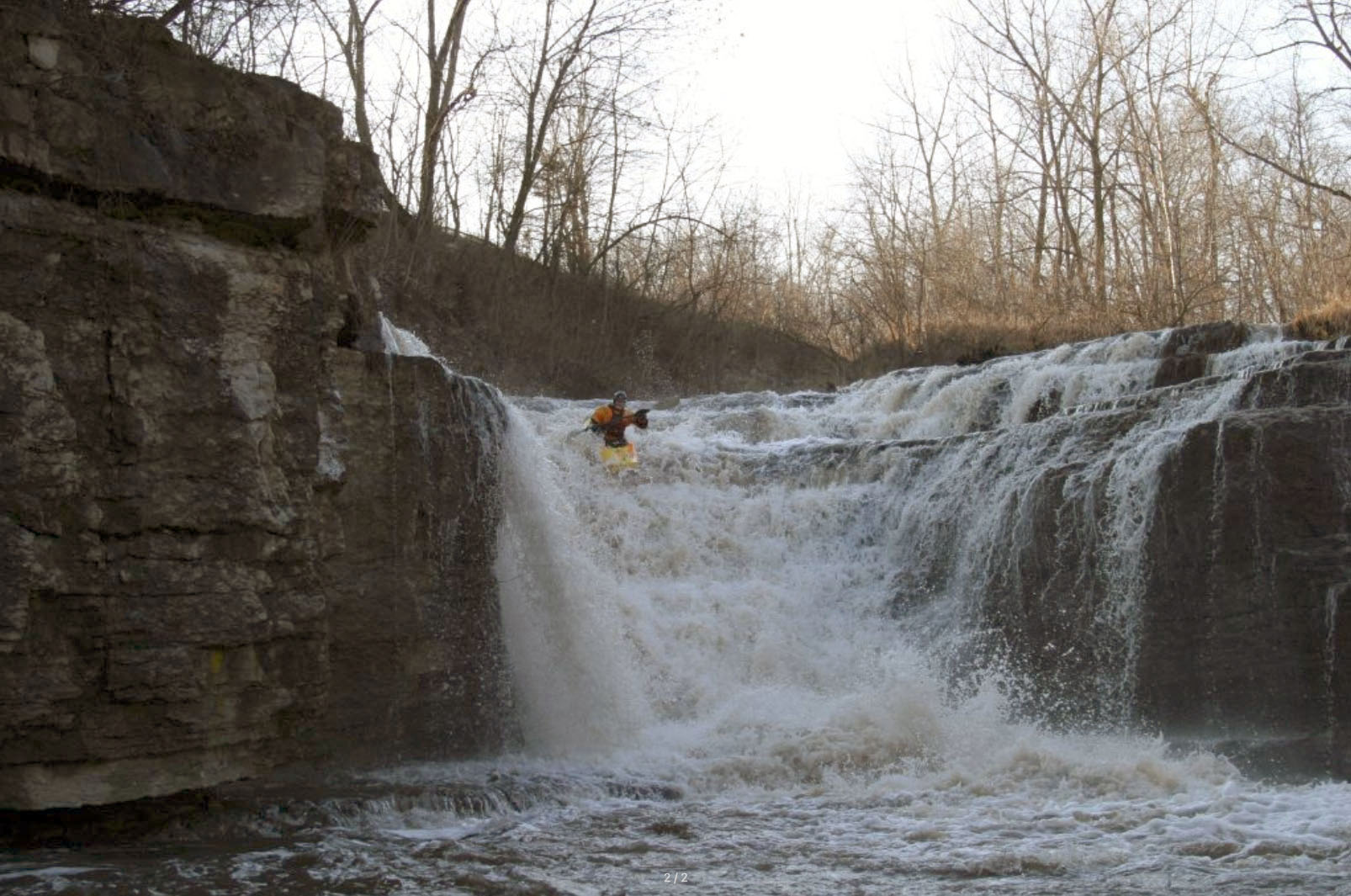
Don't try this at home.
I saw
Bailey Falls listed on a "Kayaking" web page.
This would only work after a heavy rain.

| Oglesby is located near the confluence of the Illinois River and the north-flowing Vermilion River. Originally, in 1902, the town was called Portland, due to the cement mined and manufactured in the area that was similar to Portland cement from England. In 1913, the people of Portland voted to rename the town Oglesby after Richard J. Oglesby (1824–1899), a former U.S. Senator and Governor of Illinois. Oglesby had excellent exposed limestone and coal, as well as riverine transport. It soon became an important center for cement manufacture. “Well, here it is,” said a Kenosha businessman who made it to the place now known as Oglesby in 1865, the last year of the Civil War. He was with the Kenosha Coal Company setting up operations in the untouched area south of LaSalle and the Illinois River. The company was small. It consisted of Irish, Scottish, and English workers. After one year, a shaft collapsed. It looked like all was doomed for this operation, but they did not give up hope. The company sent Mr. Thatcher Tucker Bent in to run the area in 1867. Mr. Bent made working conditions better. He gave them better wages and workers’ compensation due to the dangers of coal mine working. He soon started a Sunday school held in a company shed and a small grocery store. Cement has been an industry growing and changing in Oglesby for over 100 years. In 1891, the cement industry in Oglesby started. Although the land was bought in 1891 the company didn’t start operations until 1892.
It would be a hundred years before most of us got to go Off Road there. In 1898, the company became Marquette Cement Company. Oglesby had two major cement companies. The other major cement company was the Chicago Cement Company, which later became Lehigh Portland Cement Company. Lehigh stopped operations in 1964 and its quarry was bought by Marquette. You can still see some of Lehigh’s old buildings off Walnut Street at the edge of town in Oglesby. |

The Marquette Cement Company

| The Marquette Cement Plant in Oglesby, IL shipped its first barrel of Portland cement in 1893. The first years were lean, it was shuttered for a while. I barely remember those days. But after the 1900s the cement industry made great strides. Engineers begin to learn how to build with reinforced concrete and roads needed to be paved. After they were invented, rotary kilns were installed and increased production by a factor of 7 to 3,600 barrels a day. In the 1960's and 70's off road vehicles were invented. By the late 1970's Marquette Cement evolved into Lone Star Industries. By 1984 the quarry was no longer being used and that's when it became Off Road Heaven. For anyone lucky enough to experience those glory days. Buffalo Rock was the other mind blowing trails. Thru hillscapes from another planet. Lone Star sold the quarry to Italian Cement Company Buzzi Unicem USA Inc. in 2004. |
| But the economic crash of 2008, which hit the construction industry particularly hard, caused the quarry and mill to be shut down December 1, 2008, laying off nearly 80 union workers. Now just the railroad and silos are used as a distribution center. The railroad was bringing cement from a plant near Greencastle, IN to fill about 40 - 80 trucks a day. |

| The quarry silos were served by the CB&Q/Illinois Valley and Northern Railroad and the higher set of silos was served by the Illinois Central Railroad. In 2013, Buzzi Unicem indicated it would cost $20 million to put the plant back online, which will never happen. So they were requesting that the value of their property tax bill be cut by 75%. In fact, they removed a conveyor built to reduce the worth of their property. |
| Buffalo Pit got split up. I believe the Gun Range owns one end and Fox Valley Off Road owns the other bigger end. I have to find out the story. If you were around in those glory days of Bailey Falls you might have gone across the River by Utica to "Buffalo Pit." Back then it was all one long strip of trails. Serous trails. It was abandoned strip mined land adjacent to Buffalo Rock State Park. Except this was no state park. It was another planet. One hundred+ foot high mounds of dirt big mounds with trails like a roller coaster. It was a crazy wild place with a gun range and some serious motorcycle trails. We used to ride there in through the 80's. Someone there told me about Bailey Falls. Thats how I found out about Bailey Falls. After Roger blew himself up and Buffalo Pit closed we stuck to Bailey Falls. I think someone bought the gun range and put it in the back end. |
| We used to bring a 12 Pack O beer and ride these trails. Yes we were a little insane. I have photos and videos that are coming soon. One time we brought the dog "Heineken" was her name, and she did do some rides on the gas tank of the Yamaha XT600. Steep trails in the woods, you had to know how to get there. Most folks stayed in the front. Fox Valley Off Road bought "some" of Buffalo Pit. |

| This satelite shot is from Apple Maps the other yesterday. Back in the day when Roger and Paul Smith ran the joint it was all one big crazy trail. It looks like Gun Range people have that back end now. You can see the Chicago, Rock Island and Pacific Railroad tracks bordering the bottom half of the Pit Proper. |

| The Rock Island tracks were abandoned in 1980. There's quite a large slice of swampy and brush area between the tracks and the road. In that area there were a few dry spots where you could get in there. But you didn't go in there too trecherous. I do not remember those Farm Fields but that area was all thick forest steep hilly forest so who knows. I need to talk to some old timers that know the story. The place was legendary. |

This photo is the far end hills, to get to this back end you had to go through mordor and the deep forest.
| Don't be in there after dark.
Orgs and evil dwarves lived in the forest. Sometimes Gollum lived in the caves. Meanwhile in 1985. One of the first times I was out there. There was a friendly guy rather mysterious fella who lived in a cabin near Bailey Falls quarry. We went to his cabin. He said there were "strange stuff" phenomena going on.
He said, "Don't believe what you hear and only half of what you see." Hmm. It was very odd and the way he said it. He wasn't joking he was serious. Ten years later we were at Buffalo Pit, not riding, we paid to get in and camped overnight at the makeshift campground. That evening we walked over to the campfire across the way to drink beer with whoever they were. Sitting around the fire swapping stories I brought up this guy from 1985 the fellar in the cabin. To my surprise they knew exactly who he was. That was bizarre. |
STUCK IN THE SWAMP The time we got stuck via 4x4 in the lower Pit area was a classic. Classic nightmare! You can see a spot on the map there where it says "Very dubious area where nobody goes." That nobody refers to locals that know better. As opposed to us we were not locals and we did not know better. The Railroad tracks bordered the top of this slice of land/swamp/brush/hell with the road bordering the bottom southern side. |
It was a dry summer day so we thought lets go in there. Dry so that you COULD go in there. There were some dry spots with tire tracks to get in and thats good enough for me so we went in. The swamp in certain places had those Cattails, big ones 5 feet high, in the open area was "dried up puzzle pieces" you know that cool looking cracked earth pattern like puzzle pieces looking surface. You know everyone knows-
|
We was laughing having fun, it turns out driving on that cracked earth stuff whipping through 5 foot tall Cattails doing donuts and wide circles is a total blast. Until it isn't. On one of the wide circles the truck just slowed down down an down into slow motion like by a force field of sludge until we were all 4 tires just spinning in place. I got out and wondered why the hell we were stuck because it was not even 6 inches deep. Underneath the clay pieces was like pure ice. You couldda prolly ice skated on it the texture was so icy wet clay. A serious problem with Buffalo Pit and Bailey Falls was “wet clay.” When its dry its a beautiful hard surface, but when its wet,,,it needn’t be deep for you to be immobilized in sludgy ice. Yer big bad 4x4 tires and yer big ole motor, helpless useless in wet clay. And I had neither. Our Go-To trick that always worked was Jack Up the tire put sticks logs under the tire, go forth do it again, drive out. I tried that. The truck did not go up the Jack went down. Each pump it went down further into the greasy sludge. Needless to say this was very discouraging. I said, "Jim we have a serious problem here." I should have said, "Dammit Jim Do Something" of course we were not the USS Enterprise we were alone on a strange planet. No backup 4x4's. No tools. Of course we only had five bux left because we spent all our money on beer. And even if the Jack did go up there was no sticks no logs nothing to put under the tires it was a bloody swamp! Smart people put board bricks or blocks in the back of their vehicle. But all that or even a electric winch would not haved saved us, we had the shitty little winch, there was nothing to winch it too!
The 1992 Chicago Reader Feature article has the most comprehensive, narrative breakdown of the entire history (up to that point) of moto action Buffalo Pit in a famous investigative arts feature "Art under fire: tourist attraction closed due to flying bullets". |
contemporary art, gunfire, toxic waste, and public safety
add in dirt bikes and it sounds like a party to me
|
| Chicago Reader Art-Under-Fire Tourist-attraction-closed-due-to-flying-bullets/ |
I did not know about the railraod "Split Tunnel" on the west side of Utica. |

| In the early 1900s, the Illinois Valley Traction Company, later the Chicago, Ottawa & Peoria Railroad (CO&P), constructed an interurban line between Ottawa and Ladd. Due to limited space along the canal, an overpass was built over the Rock Island tracks and the canal, with steep ramps leading to the top of "Split Rock." By 1939, the bridge was removed, and in 1941, the Rock Island Railroad bypassed the tunnel with a new westbound track. The Split Rock Tunnel was constructed as part of the Chicago and Rock Island Rail Road Company’s expansion westward from Chicago. In 1851, planning began for a railroad roughly paralleling the Illinois & Michigan (I&M) Canal from Joliet to LaSalle. A sandstone bluff east of LaSalle, later called Split Rock, posed a significant obstacle. To avoid encroaching on canal property, the railroad opted to construct a short tunnel through the bluff rather than remove it entirely. The tunnel was a short passage through Sandstone, designed to allow the railroad to pass under the bluff while maintaining the canal’s integrity. The area had previously been blasted during the 1840s for the Illinois & Michigan Canal, which split the bluff into two sections, giving it the name Split Rock. In 1882, a second track was added by removing part of the bluff south of the tunnel to accommodate increased rail traffic. |
| The "Split Rock Tunnel" built in 1853 is notable as Illinois’ first railroad tunnel and a key engineering solution to the challenges posed by the I&M Canal and local topography. The original westbound track through the tunnel was abandoned, and the remaining eastbound track was rerouted around the bluff. The rail line currently going past the tunnel is now part of the Iowa Interstate Railroad. |

| Rock Island train #623 parked at the Joliet station in 1957. You can tell the photo is 1957 by looking at the white 4 door '57 Chevy on the right side. |
| 1978 Rock Island train leaving the Chicago station. Packed with beer and coolers headed to Bailey Falls in Oglesby Illinois. Stopping at the Utica station and unloading party Supplies for thirsty dirt bike riders. We grew up in the 1960's and 70's and saw Rock Island trains all the time, they were everywhere it seemed. |
Expansion and Growth In 1866, the Chicago and Rock Island Railroad acquired the Mississippi and Missouri Railroad, forming the Chicago, Rock Island and Pacific Railroad Company. The railroad expanded steadily through construction and acquisitions, reaching Kansas City by 1879 via an operating agreement with the Hannibal and St. Joseph Railroad. The Rock Island Line became famous in American culture, inspiring the folk song “Rock Island Line”, first written in 1929 and later popularized by Johnny Cash in 1970. The railroad carried both freight and passengers, with agriculture forming a significant part of its business. Despite its fame, the company faced operational challenges, including competition with other railroads and financial difficulties. Decline and Liquidation The Rock Island experienced financial instability in the 20th century, undergoing reorganizations in 1917 and 1947. By the 1960s, the railroad was in decline, and merger attempts with other railroads failed. Bankruptcy proceedings began in March 1975, and although federal loan guarantees temporarily kept it running, a federal judge ordered its liquidation in January 1980. Its assets were sold off piecemeal in the early 1980s. The Chicago, Rock Island and Pacific Railroad played a pivotal role in connecting the Midwest to the Mississippi River and beyond, influencing regional development and American rail culture and motorcycling/Off Roading in the LaSalle Utica Oglesby area. Its rich history reflects both the ambition and challenges of partying in cement quarries in the 19th- and 20th-century along with railroading in the United States. |
| This page is about Off Road Riding in Illinois. 4x4 trails 4 wheel driving in Illinois. Motorcycle trails in Illinois. Old train tracks and abandoned rock quarries in Illinois. Fossile hunting and Kayaking in Ottawa LaSalle County in Illinois. It's all about illinois folks, so strap in and hold on much more is coming. Here's another video from THE WHEELIE CIRCUS- |
| gh |
On another clip in the beginning we're jumping off the side cliff to the water below. That's the late Brian Rullman of Run And Gun Productions. He was a VJ DJ creator inventor Visual Effects Jedi. He brought his BMX bike And he uh. Road off a cliff. Doesn't hurt him. This surely has to be the only 16mm film clip in history of Baily Falls.
|